
The artificial intelligence boom is usually measured in chips. More powerful models require more accelerators, larger clusters and data centers capable of supplying extraordinary amounts of electricity. But as those clusters expand, computing power is becoming only part of the problem. The machines must also exchange data quickly enough to behave like a single system.
That is turning light into a critical part of the AI supply chain.
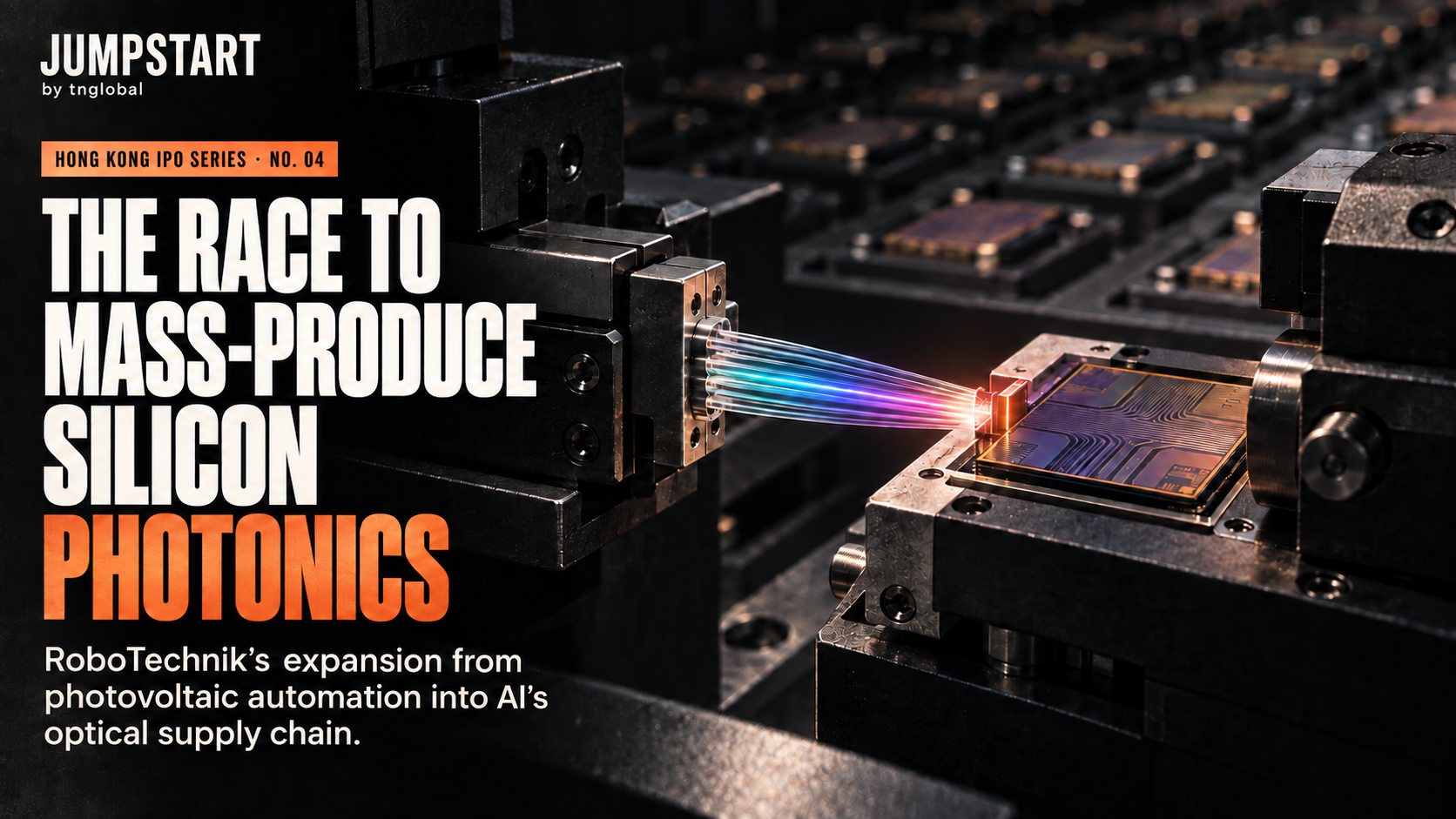
Optical connections can move large volumes of data with less power loss than conventional electrical links over longer distances. Yet the components inside those connections are difficult to manufacture. Fibers, lasers and photonic chips must be aligned with extreme precision, bonded without disturbing that alignment and tested repeatedly as they move through production. A design that works in a laboratory is of limited value if it cannot be assembled reliably by the thousand.
RoboTechnik Intelligent Technology wants to build the machines that make that transition possible.
The Suzhou-based automation specialist is preparing to list H shares in Hong Kong on September 29 under stock code 3757. Already traded on Shenzhen’s ChiNext market, RoboTechnik is offering 11.88 million shares at a maximum price of HK$436 each. At that price, it expects to receive approximately HK$4.96 billion after expenses, according to its Hong Kong prospectus.
The listing arrives in the middle of a profound change in the company’s identity. RoboTechnik was built around automation equipment for photovoltaic cell factories. Today, following the acquisition of German photonics-equipment maker ficonTEC, most of its revenue comes from machines used to assemble and test silicon-photonic devices.
This is not a simple story of a solar supplier attaching itself to AI. It is a test of whether expertise developed in one form of precision manufacturing can be transferred into another—and whether a Chinese industrial company can turn a specialized German engineering business into a platform for mass production.
Built Around the Production Line
RoboTechnik began in 2011, when founder Dai Jun established its predecessor in Suzhou, one of China’s largest advanced-manufacturing centers. Dai had previously worked in engineering, product management and industrial-equipment sales before running an electronics company.
The timing placed the new business inside the rapid expansion of China’s solar manufacturing industry. Rather than making solar cells or modules itself, RoboTechnik supplied the equipment surrounding their production.
A photovoltaic cell factory contains machines that perform processes such as diffusion, coating and etching. RoboTechnik’s early specialty was automation: loading and unloading delicate silicon wafers, moving them between production steps, inspecting them, testing their electrical performance and sorting the finished cells. These operations may sound secondary to the chemistry and physics that determine a cell’s efficiency, but they affect how quickly a factory can operate and how much material it loses through breakage or defects.
The company developed its first automated plate-type PECVD system in 2012 and introduced a broader range of wafer-handling, inspection and sorting equipment the following year. By 2017, it had extended the same logic from individual machines to intelligent-factory systems, using software to coordinate equipment, materials and production data across a facility.
RoboTechnik listed on Shenzhen’s ChiNext board in January 2019. Its core business remained closely tied to the capital-spending cycles of photovoltaic manufacturers. When cell makers built or upgraded factories, demand for automation equipment rose. When expansion stopped, orders could fall quickly.
For several years, that concentration was easy to overlook. China’s solar supply chain was adding enormous amounts of capacity, while manufacturers raced to adopt more efficient cell technologies. RoboTechnik’s revenue reached RMB1.57 billion in 2023, with photovoltaic manufacturing solutions contributing 95% of the total.
The same exposure would become a liability as industry capacity overtook demand.
A German Route Into Photonics
RoboTechnik had begun looking beyond photovoltaic manufacturing before that downturn became severe.
In April 2019, an investment bank told Dai that the owners of ficonTEC were considering a sale. Based near Bremen in northern Germany, ficonTEC traced its origins to 2001 and specialized in automated assembly and testing systems for photonic devices.
The company occupied a narrow but increasingly important part of the technology industry. Its machines did not fabricate semiconductor wafers, nor did they produce finished optical modules under the ficonTEC name. They performed the precision work between those stages: positioning photonic components, aligning optical pathways, attaching fibers and testing whether the resulting device transmitted light as intended.
Over time, ficonTEC had supplied equipment for telecom networks, data communications, high-power lasers, automotive sensing and biomedical applications. Its modular systems could be configured for research laboratories, pilot lines or industrial production. By April 2026, the company had installed more than 1,200 assembly and testing systems worldwide.
RoboTechnik saw a connection between the two businesses. Solar-cell automation and photonics require different levels of precision and serve different customers, but both depend on motion control, machine vision and software capable of coordinating physical processes. The Chinese company had experience designing factory-scale automation; ficonTEC brought specialized knowledge of optical alignment and photonic packaging.
The acquisition unfolded over six years. A consortium led by Dai created a special-purpose vehicle in 2019 and gradually acquired 93.03% of ficonTEC between that year and 2023. RoboTechnik obtained an indirect minority interest in 2020, then began the regulatory process needed to bring the German company fully onto its balance sheet. The transaction was completed in May 2025, making ficonTEC a wholly owned subsidiary.
The prolonged structure reflected both the scale of the deal and the difficulty of cross-border industrial acquisitions. RoboTechnik was not simply buying a product catalogue. Much of ficonTEC’s value resided in process knowledge, software and engineers capable of adapting machines to customers’ devices.
RoboTechnik therefore kept ficonTEC co-founder Torsten Vahrenkamp in charge of its operations. Vahrenkamp, an applied-laser specialist who helped establish the company’s predecessor in 2001, subsequently joined RoboTechnik’s board. Dai became a managing director of ficonTEC in 2023 and took a direct role in coordinating the two organizations.
There were early signs that the combination could extend beyond silicon photonics. In 2023, RoboTechnik and ficonTEC jointly delivered an automated assembly and testing line for automotive camera systems to French automotive supplier Valeo. More strategically, the group began producing parts of ficonTEC equipment through its Chinese manufacturing network and working to convert bespoke machines into more modular systems suitable for larger production volumes.
The acquisition was conceived before generative AI turned optical interconnects into one of the semiconductor industry’s most closely watched bottlenecks. That timing would transform its significance.
Why Silicon Photonics Needs Different Machines
Silicon photonics integrates components that manipulate light onto silicon-based devices. The technology makes it possible to move data using photons while retaining the manufacturing advantages and electronic functions associated with conventional semiconductors.
For AI data centers, the attraction is straightforward. Electrical connections become more difficult and power-hungry as data rates rise and computing systems grow. Optical links can carry more information over greater distances with lower signal loss. They are already widely used between switches and servers, and the industry is moving toward placing optical components closer to processors and networking chips.
Co-packaged optics, commonly shortened to CPO, pushes that idea further by placing optical engines and switching chips within the same package. Optical circuit switching, or OCS, directs data through paths made of light rather than repeatedly converting signals between optical and electrical forms. Both approaches promise improvements in bandwidth and energy efficiency, although their adoption will depend on cost, reliability and the ability to manufacture them at scale.
That last condition is where ficonTEC operates.
Light is unforgiving. A tiny error in the position of a fiber, laser or photonic circuit can weaken a signal or cause the device to fail. Unlike many conventional electronic assemblies, a complicated photonic package can be difficult or uneconomic to repair after its components have been bonded. Manufacturers therefore need equipment that can align parts at extremely small tolerances and test them at several stages—at wafer, die, chip and module level—before additional value is added.
ficonTEC sells two broad categories of machines. Its assembly systems position and attach photonic components, prepare fibers and integrate devices into production lines. Its testing systems evaluate optical, electrical or mixed signals throughout the manufacturing process. Proprietary control software coordinates motion, calibration and process data across the equipment.
This places RoboTechnik in an unusual layer of the AI economy. It is not designing GPUs, manufacturing photonic chips or selling the optical transceivers installed in data centers. It supplies some of the tools that other companies need to turn photonic designs into physical products.
That distinction also explains why its opportunity is broader—and less certain—than demand for any one optical module. The same equipment can be adapted for pluggable transceivers, CPO systems, optical switches, telecom devices, sensors and other photonic products. But customers’ designs differ, qualification takes time and many next-generation architectures are only beginning to move from experiments to commercial deployment.
A Business Rewritten in Two Years
The speed of RoboTechnik’s change is clearest in its financial statements.
In 2023, photovoltaic manufacturing solutions generated RMB1.49 billion, or 95% of group revenue. They still accounted for 92.5% in 2024. RoboTechnik was, in practical terms, a photovoltaic automation supplier with several smaller activities.
Then the solar manufacturing cycle turned sharply downward. Years of aggressive expansion left the industry with excess capacity, weak pricing and less appetite for new factories. Because RoboTechnik primarily sold production-line automation rather than the core process equipment responsible for improving cell efficiency, its orders were particularly exposed when manufacturers cut capital spending.
Revenue from photovoltaic manufacturing solutions fell from RMB1.49 billion in 2023 to RMB1.02 billion in 2024, then to RMB433.1 million in 2025. Sales of its automation machines declined from 1,932 units in 2023 to only 110 in 2025.
At almost the same moment, the consolidation of ficonTEC redrew the other side of the ledger. Silicon-photonics assembly and testing equipment contributed RMB50.2 million in 2024, when RoboTechnik was producing certain components for ficonTEC but had not yet completed the acquisition. In 2025, the segment generated RMB439.1 million and accounted for 46.3% of total revenue—slightly more than the photovoltaic business.
The shift accelerated in the first half of 2026. RoboTechnik reported RMB608.1 million in group revenue, up 145.1% from the corresponding period. Silicon-photonics equipment contributed RMB488.2 million, or 80.3% of the total, after several machines designed for mass production were delivered and accepted by customers. Photovoltaic solutions fell to RMB83 million.
The comparison is not perfect: ficonTEC was included in the first-half 2025 accounts for only about two months. Even so, the latest figures show that RoboTechnik’s center of gravity has moved decisively. As of June 30, its backlog for silicon-photonics assembly and testing equipment stood at RMB2 billion.
The new mix is also changing the company’s economics. Silicon-photonics equipment produced a gross margin of 42.9% in the first half of 2026, compared with 32.6% for photovoltaic solutions. The greater contribution from that business lifted RoboTechnik’s overall gross margin to 41.6%, from 27.8% a year earlier.
But this is not yet a clean turnaround. RoboTechnik lost RMB45 million in 2025, after earning RMB63.2 million the previous year. The company returned to a small RMB6.3 million profit in the first half of 2026, but its results remain sensitive to when large projects pass customer acceptance and can be recognized as revenue.
The transformation is therefore real, but part of it is mechanical: a large acquired company entered the consolidated accounts just as the legacy business contracted. The harder question is whether RoboTechnik can turn that change in composition into durable organic growth.
From German Precision to Industrial Scale
The strategic logic of the ficonTEC acquisition rests on combining two different kinds of manufacturing knowledge.
ficonTEC grew by solving specialized engineering problems. Its equipment is often configured around a customer’s device, production process and qualification standards. That approach builds deep technical relationships, but custom projects can take longer to design, produce and approve. It is not automatically the same operating model required to deliver standardized machines in high volume.
RoboTechnik brings experience at the scale of Chinese industrial manufacturing: production-line integration, machine vision, supply-chain management and software that coordinates entire factories. The company says it is applying those capabilities to improve the throughput and cost of ficonTEC’s systems, while using the German unit’s high-precision motion-control knowledge in its own equipment.
If that exchange works, the acquisition could solve a problem facing the photonics industry. A growing number of companies can design advanced optical devices, but fewer suppliers can provide the automated equipment needed to assemble them repeatedly at commercial volumes. According to research commissioned for the prospectus, RoboTechnik and ficonTEC together held 20.5% of the global intelligent silicon-photonics manufacturing-equipment market by revenue in 2025.
Yet the prospectus also makes clear that integration is still at an early stage. The two businesses serve different customers, use different suppliers and operate with different cost structures. Production is distributed across sites in Suzhou and Nantong in China and two facilities in Germany. Preserving ficonTEC’s technical culture while lowering costs and accelerating delivery will require more than shifting procurement from one country to another.
The project-based nature of the business adds another challenge. RoboTechnik recognizes much of its revenue only after equipment has been installed, commissioned and accepted by the customer. More complicated machines can take longer to qualify, producing large swings between reporting periods even when the order book is growing.
Customer concentration is also significant. The five largest customers generated 64.2% of group revenue during the first four months of 2026, while the largest accounted for 33%. Four of those five customers came from the silicon-photonics business. Winning a place in the production plans of a major AI-infrastructure company can create substantial revenue; a delayed qualification or revised architecture can have the opposite effect.
Dai has attached his own guarantee to the deal. Under an agreement signed in March 2025, he pledged that ficonTEC would produce at least EUR58.1 million in cumulative net profit over the three years ending in 2027, with cash compensation due for a shortfall, subject to an agreed cap. The arrangement underscores both management’s confidence and the financial expectations now resting on the German subsidiary.
What the Hong Kong Listing Is Financing
RoboTechnik’s Hong Kong offering is not its first encounter with public markets. It has been listed in Shenzhen for more than seven years, and its A shares will continue trading after the H-share listing. For international readers, it is better understood as a dual listing than as the debut of a private startup.
The use of proceeds reveals which part of the company investors are being asked to finance. At the maximum offer price, RoboTechnik plans to allocate 40% of the net proceeds to production capacity and faster delivery, particularly for silicon-photonics manufacturing equipment. Another 20% is intended for research and development across silicon photonics and photovoltaic equipment.
The company has earmarked a further 20% for acquisitions or strategic investments, 10% for a global sales and service network and 10% for working capital. In other words, most of the offering is designed not to repair the old photovoltaic business, but to industrialize and extend the newer one.
That ambition comes with the usual risk of building ahead of demand. Silicon photonics is gaining commercial momentum, but forecasts for CPO, optical switching and other emerging architectures depend on the investment plans of a small number of powerful chip and cloud companies. Technical standards can change. Customers can postpone deployment. Equipment that appears essential during a pilot program may need to be redesigned before mass production.
RoboTechnik is also carrying the complications of its recent acquisition. Fixed operating costs, financing expenses and amortization associated with ficonTEC contributed to the group’s 2025 loss. Integration must progress while both organizations continue delivering machines to customers that cannot tolerate errors.
Still, the company has reached Hong Kong with something more substantial than an AI narrative. It owns a photonics-equipment business founded long before the current boom, an installed base accumulated across multiple industries and a growing order book that has begun moving from pilot systems to production machines.
The Equipment Behind the Architecture
RoboTechnik’s evolution reflects a broader change in the technology industry. As computing systems become harder to scale, competitive advantage is moving beyond chip design into packaging, interconnects, thermal management and manufacturing equipment.
These layers rarely receive the attention given to a new processor. They become visible when they prevent the rest of the system from advancing.
For RoboTechnik, the opportunity is to turn ficonTEC’s specialized expertise into one of those enabling layers. The company does not need every version of silicon photonics to succeed. It needs enough optical devices to enter mass production—and enough manufacturers to conclude that buying precision automation is more reliable than building it themselves.
The risks run in the other direction. If adoption takes longer than expected, RoboTechnik will be left carrying the fixed costs of a global engineering organization while its photovoltaic business remains weak. If it pushes standardization too aggressively, it could undermine the customization and process knowledge that made ficonTEC valuable. If integration proceeds too slowly, competitors may close the gap as the market expands.
That makes the company’s transformation more interesting than a conventional pivot. RoboTechnik is trying to join two industrial cultures, two production models and two very different technology cycles at precisely the moment when AI is turning optical manufacturing from a specialist discipline into strategic infrastructure.
Silicon photonics may help determine how far AI systems can scale. Before that happens, someone must build the machines capable of assembling it.