
At night, some of the most consequential robots in China are the ones nobody notices.
They move quietly through hotel corridors, wait for elevators, carry deliveries across campuses and clean underground car parks after most people have gone home. They do not walk like humans, hold conversations or perform on a stage. Their value lies somewhere less dramatic: they show up, complete a defined task and do it again the next day.
This is the world Excelland Robotics has been building in for more than a decade.
Founded in Shenzhen in 2013, Excelland started with robot control systems before moving into complete commercial service robots. Its machines now operate across hotels, offices, entertainment venues, campuses, shopping malls and transportation hubs. The company is preparing to list in Hong Kong under the name Excelland Robotics (Wuxi) Co. Ltd., but its story began long before the IPO—in a period when “commercial robotics” meant persuading businesses to trust machines with ordinary work.
The company’s prospectus describes a business that had sold more than 114,600 robots to over 5,100 customers globally as of March 2026. Behind that number is a particular approach to robotics: start with a narrow task, build a product around it and gradually expand the technology into more complicated environments.
The result is not one universal machine. It is a family of robots designed to make automation fit into the places where people already work.
The First Job Was Delivery
Excelland’s first major product was Yomie, an indoor delivery robot launched in 2016.
The timing mattered. Hotels and entertainment venues were looking for ways to handle repetitive service tasks while dealing with rising labour costs and high staff turnover. A delivery robot did not need to replace an entire employee. It needed to move an item from one point to another, reliably enough that staff could spend more time on work that required human attention.
Excelland followed Yomie with Yodee in 2017, a higher-capacity indoor delivery robot aimed at leisure and entertainment venues. It later introduced the Yogel line for on-demand delivery and campus applications.
By 2019, the company’s robot shipments had exceeded 2,500 units. In 2021, cumulative shipments passed 10,000. These were still small numbers compared with the mass-market hardware businesses that dominate China’s technology industry, but commercial robots operate under a different standard. Every deployment is also an operating environment, a source of data and a test of whether a product can survive outside the laboratory.
A robot that works once is a demonstration. A robot that works every day is a business.
That distinction has shaped Excelland’s development. Instead of betting everything on a single breakthrough product, the company has built a portfolio around specific jobs.
Yomie focuses on indoor delivery and guest guidance. Yodee is designed for larger-capacity indoor delivery. Yogel supports on-demand delivery. Yoxiaogu is built for cleaning, both indoors and outdoors. Yoshop is a family of vending robots for unmanned retail.
The names may be unfamiliar outside China, but the commercial logic is straightforward. Each product is designed around a setting where the task is repetitive, measurable and difficult to staff efficiently.
From Hotel Corridors to Harder Environments
Indoor delivery was only the beginning.
The company introduced indoor cleaning robots in 2022 and outdoor cleaning robots in 2023. That shift took Excelland into more demanding environments, where the robot could no longer depend on a predictable corridor or a controlled building layout.
An underground car park, for example, can be exposed to heat, exhaust fumes and vehicle traffic. Outdoor spaces introduce uneven surfaces, changing light, pedestrians and obstacles that may not exist the next time the robot passes through the same area.
These environments require more than a motor and a map. They require the machine to understand where it is, identify what is around it and make decisions as conditions change.
Excelland says its technology has evolved from systems built mainly around LiDAR and simultaneous localization and mapping to a multi-sensor architecture that combines cameras, LiDAR and other onboard sensors. Its robots use these systems to perceive obstacles, identify pathways, recognize facilities such as elevator panels and adjust their movements.
The company’s newest Yomie models show how small technical improvements can have commercial consequences.
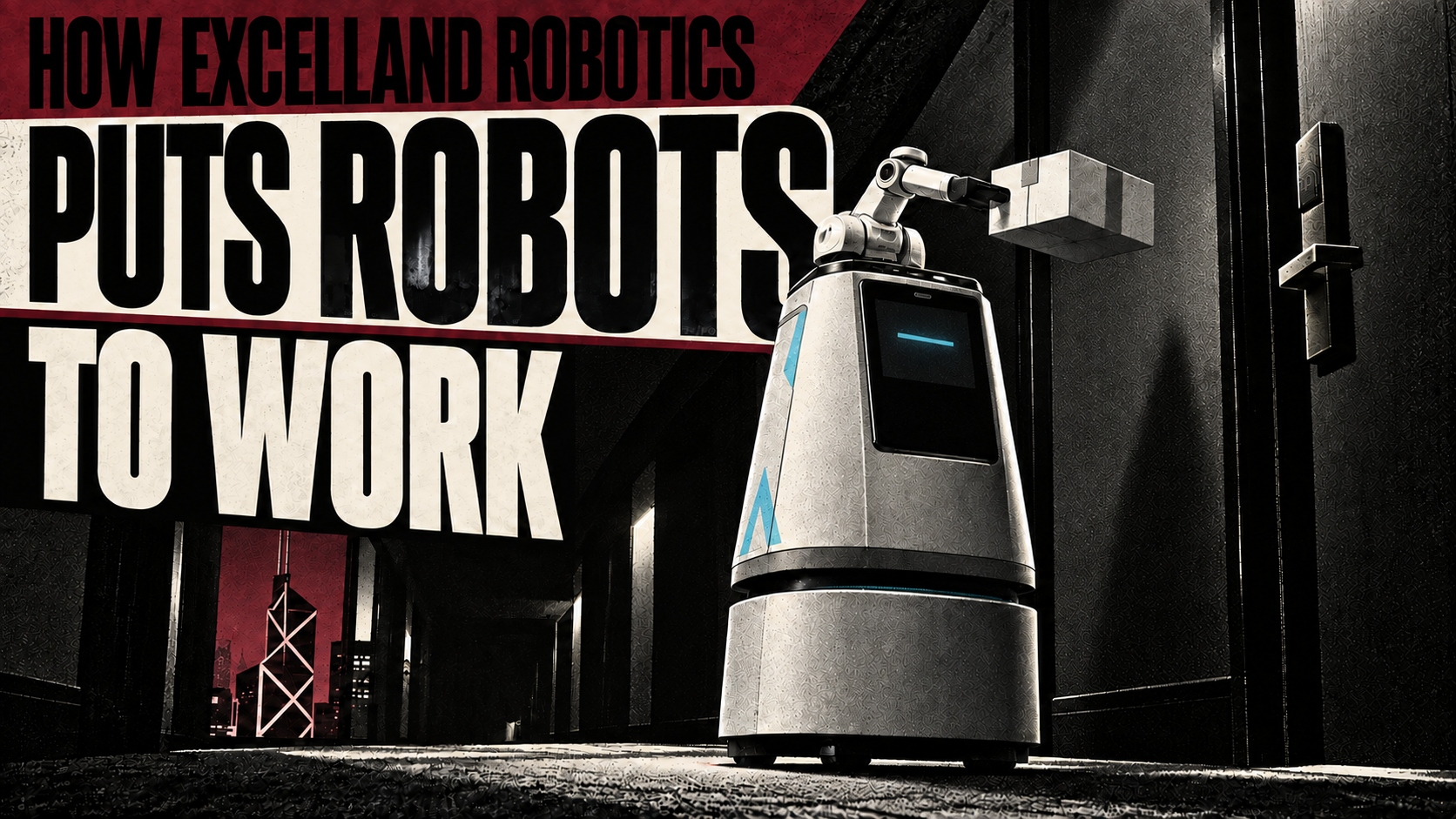
The Yomie MX, launched in March 2026, is designed to complete multi-floor deliveries without requiring an elevator to be retrofitted with an Internet of Things system. Using visual recognition and an intelligent robotic arm, it can identify and press elevator buttons.
For a human, pressing an elevator button is barely an action. For a robot, it is a combination of perception, positioning, motion control and physical interaction. The machine must recognize the panel, move into the right position, operate the button and continue its route.
Commercial robotics is full of such apparently minor problems. The companies that solve them are often more valuable than the companies that merely produce the most impressive demonstration.
The Machine Is Only Half the Product
Excelland’s technology is spread across both the robot and the cloud.
The edge-side system handles real-time functions such as visual perception, positioning, navigation and motion control. The cloud side supports data management, model training, task coordination, remote management and ongoing optimization.
This cloud-edge architecture allows the company to reuse its underlying capabilities across different products. A perception system developed for delivery robots can contribute to cleaning or vending applications. Data from deployed machines can help refine algorithms and improve the performance of future products.
The same technology is also being commercialized outside robotics.
Through its Yoware platform, Excelland provides AI vision model solutions for industries including construction, building installation, sports, education, food production and media. These solutions can analyze images and video for functions such as object detection, scene recognition and anomaly detection.
That business changes the way Excelland should be understood. It is not only a robot manufacturer. It is also trying to become a provider of visual intelligence that can be deployed on cameras, edge computing devices and existing customer systems.
In 2025, the company generated RMB119.2 million from AI vision model solutions, representing 37.5% of total revenue. Robotic product sales contributed RMB135.0 million, while robots-as-a-service generated RMB49.9 million.
The numbers suggest that Excelland is gradually moving away from a simple hardware model. Its future may depend on whether it can turn the technology developed for physical robots into software, services and operating systems that customers continue to use.
Selling the Outcome, Not Just the Robot
The company is also experimenting with a different relationship with customers.
Under its robots-as-a-service model, Excelland retains ownership of the robot and deploys it at a customer site. Customers typically pay according to completed delivery orders or the amount of time a cleaning robot operates.
This approach is important because the upfront price of a robot is only one part of the adoption decision. A hotel operator or cleaning company is more interested in whether the machine can lower operating costs, reduce staffing pressure and deliver a predictable return.
A service model can make that decision easier. Customers pay for the work rather than simply purchasing the equipment. Excelland, meanwhile, remains involved in deployment, maintenance and operational support.
The model also creates a potential source of recurring revenue, although it comes with its own challenges. The company must manage its own fleet, keep machines working and absorb more of the operational risk.
Excelland’s revenue increased from RMB243.8 million in 2023 to RMB317.7 million in 2025. But it remained loss-making, reporting a net loss of RMB110.8 million in 2025 and RMB31.2 million in the first three months of 2026.
That is the less glamorous side of the robotics business. Building a fleet requires research, manufacturing, service infrastructure and customer acquisition before the benefits of scale fully appear.
Excelland’s five largest customers accounted for 76.4% of revenue in 2025, while its largest customer contributed 36.7%. The company also faces pricing pressure in hotel delivery robots, where competition has pushed down average selling prices.
The commercial question is therefore not simply whether Excelland can sell more robots. It is whether each deployment can become more efficient, more repeatable and more profitable.
A Cautious Bet on Embodied Intelligence
The language around robotics is changing quickly.
A few years ago, a company like Excelland would have been described mainly as a maker of service robots. Today, it is also talking about vision-language models, robotic arms, vision-language-action systems and embodied intelligence.
The shift reflects a wider ambition across the robotics industry: to build machines that can interpret their environments, understand instructions and perform more complex tasks.
But Excelland’s path is different from that of a humanoid robotics startup starting from a blank sheet of paper. The company already has robots operating in commercial environments, along with deployment data, customer relationships and experience integrating hardware with software.
That installed base could become an advantage if the company can use it to develop more capable systems. It could also become a constraint if the economics of existing products remain weak or if newer technologies require another long and expensive cycle of development.
For now, it is more accurate to say that Excelland is trying to use its commercial robotics platform as a foundation for embodied intelligence—rather than claiming that it has already become an embodied-intelligence company.
The distinction matters. Its current machines are still mostly specialized systems designed for defined tasks. Their strength is reliability within a particular environment, not general-purpose reasoning.
The Next Chapter Begins Outside China
Excelland plans to expand its products into selected overseas markets, including Thailand, Japan and South Korea. It has already shipped Yoxiaogu cleaning robots to South Korea and Yomie delivery robots to Japan, while exploring opportunities in Europe, North America, Malaysia and Singapore.
The opportunity is understandable. Hotels, campuses, shopping centres and cleaning operators around the world face many of the same labour and efficiency pressures. But international expansion will require more than translating a product manual. Robots must comply with local certifications, operate within unfamiliar buildings and meet different expectations around service, safety and maintenance.
That is where the Hong Kong listing enters the story.
Excelland is expected to begin trading under stock code 03231. The company says it plans to use the proceeds to expand research and development, strengthen sales and marketing, pursue strategic acquisitions and fund broader business expansion.
The IPO is therefore less a conclusion than a measure of confidence. Excelland is asking public-market investors to believe that the practical robots already working in hotels, offices and campuses can become the foundation of a larger technology platform.
The company’s future will not be decided by whether robots can produce a spectacular demo. It will be decided in the quiet moments: when a machine reaches the right floor, avoids the obstacle in its path, completes the task and returns to work the next day.
That may be the real test of commercial robotics—not whether a machine can look human, but whether it can become dependable enough to be part of the workplace.